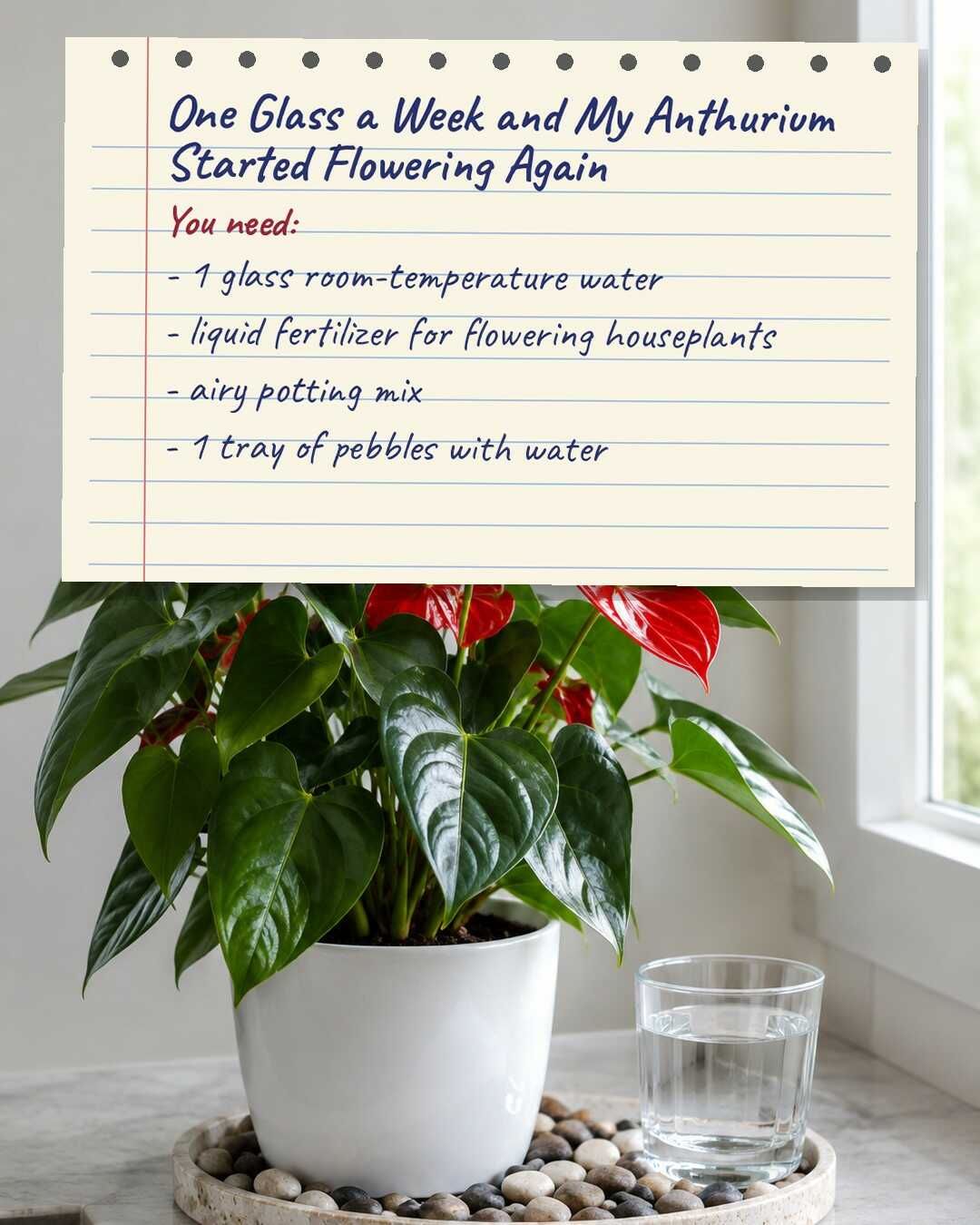
My anthurium arrived from the florist covered in red hearts and, a few months later, had none. The leaves kept coming but got smaller and smaller. I had been treating it like any other houseplant, in heavy wet soil and a shady spot. Anthuriums grow on trees and rocks in tropical forests, with roots that need air as much as water. Once I gave mine an airy mix, one glass of water a week given properly, a weak feed and some humidity, the flowers came back. There is no single magic liquid; there is a routine.
What you need
- 1 glass (about 1 cup, 250 ml) room-temperature water
- a few drops (quarter to half the label dose) liquid fertilizer for flowering houseplants
- enough to fill the pot airy potting mix (houseplant soil, orchid bark and perlite in equal parts)
- 1 tray of pebbles with water
How to do it
- Check the potting mix. If your anthurium is in dense, soggy soil, repot it in spring into a chunky mix of one part houseplant soil, one part orchid bark and one part perlite. The roots should be able to breathe; dark mushy roots are a sign they have been suffocating.
- Water about once a week, by touch. When the top inch (2 to 3 cm) of mix is dry, pour one glass, about 1 cup (250 ml) for a 6-inch (15 cm) pot, slowly over the surface until it drains. Empty the saucer. In winter you may only need to water every ten days.
- Feed lightly. From spring to early autumn, add a few drops of a fertilizer for flowering plants to the glass every two to three weeks, at a quarter to half of the label dose. Anthuriums are sensitive to salt buildup, so weak and regular is far better than strong and rare.
- Give it bright, indirect light. An anthurium in shade will grow leaves but rarely flowers. A spot near an east window, or a few feet from a south or west one, is ideal. Harsh direct sun bleaches and burns the leaves.
- Raise the humidity. Stand the pot on a tray of pebbles with a little water, making sure the base of the pot sits above the water line, or group it with other plants. Keep it away from radiators, which dry the air quickly in autumn and winter.
- Remove spent flowers. When a spathe fades to green or brown, cut its stem at the base with clean scissors so the plant can put its energy into new buds.
Good to know
- Each anthurium flower lasts for weeks, often six to eight, so a healthy plant can look almost constantly in bloom.
- Yellow lower leaves usually mean overwatering; brown, crispy edges mean dry air or too much fertilizer.
- Anthurium sap is irritating and the plant is toxic if eaten, so keep it away from pets and children.
Six months after repotting and switching to my weekly glass, mine has four red flowers open at once. It was worth the change.